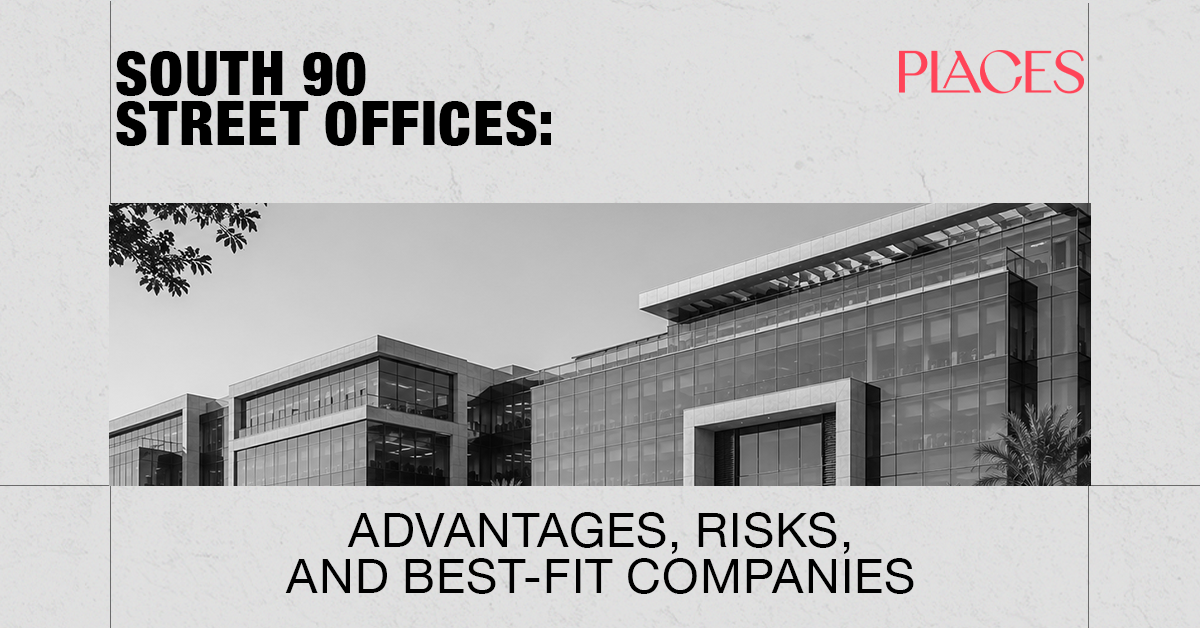
South 90 Street has become an important office location for companies considering New Cairo, especially those looking for a balance between access, newer projects, operational calm, and more measured visibility. It is often considered by businesses that want to stay within the Fifth Settlement and New Cairo office market, but do not necessarily need the highest level of street exposure associated with more visible commercial corridors.
The main advantage of South 90 Street is that it can offer a more balanced office decision. In selected projects, companies may find newer buildings, more organized environments, practical access, and potentially better alignment between cost and daily use. For companies that do not rely heavily on walk-in visibility or constant client traffic, South 90 can be a strong alternative to more exposed locations.
But South 90 Street is not automatically the better-value option. Some projects may still be building occupancy, surrounding services, and daily activity. A newer project can look strong in presentations but still require careful review of access, parking, building management, actual tenant mix, services, and the experience of using the office every day.
The right question is not: “Is South 90 Street better than North 90 Street?” The better question is: “Does South 90 Street fit our company’s operating model, and is this specific project ready enough for our team, clients, and future plans?”
This guide is written for companies, founders, operators, regional teams, and investors evaluating South 90 Street offices before leasing or buying.
Why South 90 Street matters in New Cairo
South 90 Street matters because it adds depth to the New Cairo office market. New Cairo is not one single office location. North 90 Street may be stronger for visibility and recognition, business parks may offer more corporate settings, serviced offices may provide flexibility, and South 90 Street can offer a different mix: newer projects, calmer surroundings in selected locations, and a potentially more practical balance for some businesses.
For companies that want to be in New Cairo but do not need the most visible address, South 90 can be worth serious consideration. It may suit businesses that care about office quality, employee comfort, controlled access, and cost efficiency more than maximum street exposure.
South 90 is also relevant because many companies today are not choosing offices only for prestige. They are asking more operational questions: Can the team arrive easily? Is parking manageable? Is the building well run? Are services nearby? Is the lease or purchase cost justified by daily use? Is the project active enough to support business operations?
That is where South 90 can become attractive. It may offer a location within New Cairo while giving some companies a more balanced experience than busier, more visible corridors. But that balance depends heavily on the specific project, building, and unit.
The main advantage: newer projects and potentially better organization
One of South 90 Street’s strongest selling points is the presence of newer office and mixed-use projects in selected areas. For companies, newer projects may mean better planning, more modern entrances, improved common areas, stronger building systems, more efficient layouts, and a cleaner visitor experience.
This can matter for companies that want a professional office without being in a highly congested location. A newer, well-managed project can improve employee experience, client perception, and long-term usability. It may also help companies that need a more modern work environment but do not want to pay only for visibility.
However, “newer” does not always mean “better.” A new project still needs to prove that it works in real daily use. It should have active building management, enough occupancy, reliable elevators, clear parking rules, working services, and a tenant mix that supports the professional image of the business.
A company should not choose South 90 because a project looks modern in photos. It should choose South 90 because the project is operationally ready, professionally managed, and aligned with how the business will use the office.
Visibility: less exposure can be a benefit or a limitation
Compared with more visible office corridors, South 90 Street may offer less immediate exposure in some locations. For certain companies, that is not a problem. For others, it can be a limitation.
If the business depends on walk-in activity, frequent client visits, strong street recognition, or being immediately easy to describe to a broad customer base, then lower visibility may weaken the case for South 90. A client-facing law firm, financial advisory firm, training center, or medical-related administrative use may need to check whether the specific project is recognizable enough for its visitors.
But if the company works mainly through scheduled meetings, referrals, online channels, business-to-business relationships, or internal operations, lower visibility may not matter much. In fact, a calmer setting can be better for teams that need focus, stability, and lower daily friction.
Visibility should not be treated as automatically good or bad. It should be measured against the business model. If visibility creates revenue, trust, or easier client movement, it has value. If it is mostly unused, the company may be better served by a location that offers better building quality, parking, layout, or cost control.
Access: practical, but project-dependent
Access is one of the most important factors when evaluating South 90 Street offices. A location may look close to key roads on the map, but the real question is how employees, clients, and visitors reach the building during working hours.
Some South 90 projects may offer smooth access and a calmer arrival experience than more congested locations. Others may require less obvious routes, weaker signage, or more explanation for first-time visitors. The difference can be significant from one project to another.
Companies should test access from multiple directions. Can employees reach the office easily from their residential areas? Can clients find the location without confusion? Is the entrance obvious? Are there alternative routes if one road is busy? Is the project easy to explain in a message or on a call?
For companies that rely on regular client visits, access is part of the customer experience. For internal teams, access affects punctuality, comfort, and employee satisfaction. For investors, easy access can improve tenant demand. A good South 90 office is not just near a road; it is easy to use.
Occupancy: the key risk to review carefully
Occupancy is one of the most important risks in South 90 Street office decisions. A project may be new, attractive, and well designed, but if it has low actual occupancy, the business environment may not feel complete yet. Services may be limited, footfall may be weak, and the project may still be waiting to develop a stronger business community.
Low occupancy is not always a reason to reject a project. In some cases, entering early can be a good decision if the price, building quality, developer, location, and future demand are all strong. But it changes the risk profile. A company that needs immediate operations should be more cautious than an investor with a longer time horizon.
Companies should look for signs of healthy occupancy. Are there businesses operating now? What types of tenants are present? Are common areas active during working hours? Are services open? Does the project feel like a functioning workplace or a future promise?
The best South 90 projects are not only modern; they are active enough to support daily business use. For leasing, this affects employee and client experience. For buying, this affects future rental demand and resale logic.
Services around the project: convenience affects daily work
Office decisions are not made inside the unit only. Surrounding services matter. Employees need food, cafés, banking, printing, pharmacies, transportation options, and daily convenience. Clients and visitors also benefit from a location that feels practical and supported.
South 90 Street may offer strong services in some points and less developed surroundings in others. A company should not assume that all services are already active just because the project is located in New Cairo. The practical question is what is available today, not only what is planned later.
For companies that work long hours, host meetings, or need employees to stay on-site for most of the day, services can affect satisfaction and productivity. For training providers or client-facing companies, services around the building can also affect the visitor experience.
If a company needs immediate usability, incomplete services may be a real problem. If the company is renting flexibly, it may tolerate some development risk. If the company is buying, the same issue becomes more important because it affects long-term value and tenant demand.
Parking: still a decisive factor
Parking remains a decisive factor for South 90 Street offices, just as it is across New Cairo. Even if a project is newer or calmer, companies should not assume that parking is automatically sufficient. The parking experience should be checked before leasing or buying.
Companies should ask whether parking spaces are allocated, whether visitor parking is available, whether parking is included or charged separately, how garage access works, and whether the project can handle peak-hour demand. A company should also check if parking rules are clear and properly managed.
For employees, parking affects daily comfort. For clients, it affects the first impression before the meeting begins. For investors, it affects the attractiveness of the unit to future tenants. A building with weak parking can lose value even if the location and unit look strong.
A South 90 office with good access and organized parking may outperform a more visible office with daily parking stress. That is why parking should be treated as part of the office’s core value, not as a secondary feature.
Building quality: the real test behind the project name
A project name can create interest, but the building experience decides whether the office works. Companies should review the entrance, reception, elevators, security, common areas, maintenance, restrooms, air conditioning systems, fire safety, signage rules, and visitor management.
This is especially important in newer projects. A building may look strong in marketing material but still need time to prove how well it is operated. The company should not evaluate only the unit. It should evaluate the full experience from arrival to daily use.
For client-facing businesses, building quality affects trust and image. For employee-heavy companies, it affects comfort and productivity. For investors, it affects tenant demand and resale value.
A practical way to test building quality is to walk through the project like a visitor. How easy is it to enter? Does the building feel active and managed? Are elevators reliable? Are common areas clean? Is maintenance visible? Does the tenant mix fit the company’s desired image?
Best-fit companies for South 90 Street offices
South 90 Street can be a good fit for companies that want a New Cairo location without depending mainly on high street visibility. It may suit businesses that operate through scheduled meetings, internal teams, digital channels, or business-to-business relationships.
Technology companies may benefit from South 90 if the building offers efficient layouts, good infrastructure, natural light, parking, and a calmer environment. Professional services firms may also find value if they receive clients by appointment rather than relying on frequent walk-in traffic.
Back-office teams, administrative departments, support functions, and hybrid teams may find South 90 suitable because their main priorities are cost efficiency, employee access, layout, and stability rather than maximum exposure.
Regional teams entering Egypt may also consider South 90 if they want a modern New Cairo base with lower friction and more balanced cost than highly visible locations. However, they should check whether the location is recognizable enough for visiting partners and clients.
Training providers, medical-related administrative uses, and client-heavy services can still consider South 90, but they need deeper checks around visitor flow, parking, permitted activity, room layout, and project recognition.
When South 90 may not be the right fit
South 90 may not be the right fit if the business depends heavily on visibility, frequent client visits, or immediate address recognition. If clients must be able to identify the location instantly, a more visible corridor or business park may be more suitable.
It may also be unsuitable if the chosen project has low occupancy, weak services, unclear access, or limited parking. A good location concept does not compensate for a project that is not ready for daily use.
Companies with large teams should also be careful. A newer building may look attractive, but it must be able to support actual headcount: elevators, parking, restrooms, building systems, security, and nearby services must all be tested.
For investors, South 90 may not be suitable if the unit depends too much on future demand and does not have a clear tenant profile today. The investment case should be based on realistic rental demand, not only expected area growth.
Leasing on South 90 Street: what to check
Leasing an office on South 90 Street can be a strong option for companies that want flexibility, a newer project environment, and a New Cairo location without making a purchase commitment. It can work well for companies testing New Cairo, growing teams, or businesses that are still clarifying their office needs.
Before signing a lease, companies should check the rent, maintenance charges, annual escalation, security deposit, fit-out responsibility, rent-free period, parking terms, activity permissions, repair obligations, and exit conditions. A lease should not be evaluated from the monthly rent alone.
If the office is in a newer project, it is especially important to check what is actually delivered and operational. Are elevators working fully? Are services open? Is security organized? Are common areas maintained? Is there enough activity in the project to make it comfortable for employees and clients?
Leasing can reduce long-term risk, but only if the contract remains flexible and the office can support immediate operations.
Buying on South 90 Street: what to check
Buying an office on South 90 Street can make sense for companies that want a long-term New Cairo base or investors who believe in the project’s future demand. However, buying requires a deeper view than leasing because the capital commitment is larger and the exit is less flexible.
Owner-occupiers should ask whether the office will still fit the business in several years. Is the area suitable for the team and clients? Is the unit layout flexible? Can the company grow? Is the building quality strong enough for long-term use?
Investors should focus on tenant demand. Who is likely to rent this office? What type of company would prefer South 90? Is the unit size practical? Is the building active enough? How long might the vacancy period be? What are the maintenance and fit-out costs? Can the unit be resold if needed?
A South 90 purchase can be attractive when the project is strong, the unit is practical, the price reflects the current risk, and the future tenant profile is clear. It becomes risky when the decision depends mainly on general expectations that the area will grow.
South 90 vs North 90: how to compare properly
North 90 Street is often stronger for visibility, recognition, and client-facing use. South 90 Street may be stronger for companies seeking balance, newer projects, calmer environments, or better cost-to-value alignment in selected locations.
The comparison should not be reduced to which street is better. The right comparison is based on business use. If clients visit frequently and address recognition matters, North 90 may be stronger. If the company needs a practical New Cairo office for an internal or appointment-based business, South 90 may offer better value.
North 90 can justify a premium when visibility creates business value. South 90 can justify consideration when the project quality, access, parking, and cost support daily operations. In both cases, the building and unit matter more than the street name.
A company choosing between the two should visit both locations during working hours, test access, compare parking, review building quality, calculate total cost, and decide based on operating model rather than general reputation.
Total cost: do not compare rent or price alone
South 90 offices should be compared by total cost, not only headline rent or purchase price. The real cost includes rent or acquisition price, maintenance, fit-out, furniture, utilities, internet, parking, moving cost, setup time, lease escalation, and future exit risk.
A newer project may require more fit-out or setup time. A ready-to-move office may cost more but reduce operational delay. A lower-priced unit may become expensive if services are incomplete or if the company needs to invest heavily before operating.
For buyers, total cost also includes holding cost, vacancy risk, maintenance during non-use, resale timeline, and potential fit-out changes for future tenants. For tenants, total cost includes the cost of being locked into a space that may not fit if the team grows or the business model changes.
A good South 90 decision should answer one question clearly: does this office deliver enough operational value for the full cost and risk?
Common mistakes when choosing a South 90 office
The first mistake is assuming that newer always means better. Newer projects can be attractive, but they must prove actual operational readiness.
The second mistake is ignoring occupancy. A project with low business activity may not support daily office use or immediate tenant demand.
The third mistake is comparing South 90 with North 90 based only on price. The real comparison should include visibility, access, parking, services, building quality, and company fit.
The fourth mistake is overlooking surrounding services. Employees and clients need a practical environment, not only a good unit.
The fifth mistake is buying based on future expectations only. Future growth can be part of the decision, but it should not replace current due diligence.
The sixth mistake is ignoring the unit layout. A strong project with an inefficient unit can still become a weak office decision.
How Places helps companies evaluate South 90 offices
At Places, we do not present South 90 Street as simply a cheaper or quieter alternative to North 90. We evaluate it according to the company’s operating model and the specific project’s readiness.
We start by understanding the business: team size, client visits, employee locations, daily operations, budget, lease or purchase strategy, fit-out needs, parking requirements, and growth plans. Then we evaluate the location, project, building, unit, occupancy, services, total cost, and exit potential.
For one company, South 90 may be a smart and efficient choice because it offers balance, newer projects, and a calmer environment. For another, it may be too early or not visible enough. For an investor, the decision depends on tenant demand, building quality, and realistic timing.
Our role is to help businesses see the real decision behind the listing. A South 90 office should not only look promising. It should work for the company after signing, after moving in, and later if the business needs to grow, lease, or sell.
Frequently asked questions about South 90 Street offices
Is South 90 Street a good office location?
Yes, South 90 Street can be a good office location for companies seeking a New Cairo address, newer projects, and a more balanced operating environment. However, each project should be checked for occupancy, services, parking, access, and building management.
Is South 90 Street better than North 90 Street?
Not always. North 90 Street is usually stronger for visibility and client recognition, while South 90 Street may be better for companies looking for newer projects, calmer surroundings, or better cost-to-value balance. The right choice depends on the business model.
What type of companies fit South 90 Street offices?
South 90 can fit technology companies, internal teams, professional services with scheduled meetings, regional teams, back-office operations, and companies that want New Cairo access without relying mainly on street visibility.
What are the main risks of South 90 Street offices?
The main risks are low occupancy, incomplete surrounding services, unclear access, weak parking, uneven building management, and buying or leasing based on future expectations rather than current usability.
Should startups consider South 90 Street?
Startups can consider South 90 if they need a practical New Cairo office with balanced cost and flexible growth. However, they should avoid long commitments if the team size or operating model is still changing.
Is South 90 Street suitable for investors?
It can be suitable if the project is strong, the unit is practical, the price reflects current risk, and there is a clear tenant profile. Investors should assess vacancy risk, fit-out cost, maintenance, and resale potential.
What should companies check before leasing or buying on South 90?
Companies should check access, occupancy, surrounding services, parking, building quality, layout, fit-out condition, lease or purchase terms, total cost, and whether the location fits employees and clients.
Final thoughts
South 90 Street is not just a secondary option to North 90 Street. It has its own logic. It can work well for companies that want a New Cairo office with newer projects, balanced cost, practical access, and a calmer working environment in selected locations.
But the decision must be made carefully. South 90’s strengths depend on the specific project, actual occupancy, surrounding services, building management, parking, unit layout, and business fit. A modern project is not enough if it is not ready for daily operations. A lower cost is not enough if the company faces hidden friction after moving in.
For client-heavy businesses, visibility and visitor access must be tested carefully. For internal teams, employee comfort, layout, parking, and cost may matter more. For investors, tenant demand and exit potential should guide the decision.
The best South 90 office is not simply the newest or most attractive listing. It is the office where the location, project, building, unit, and total cost support the company’s real operating model.
Leave a Reply