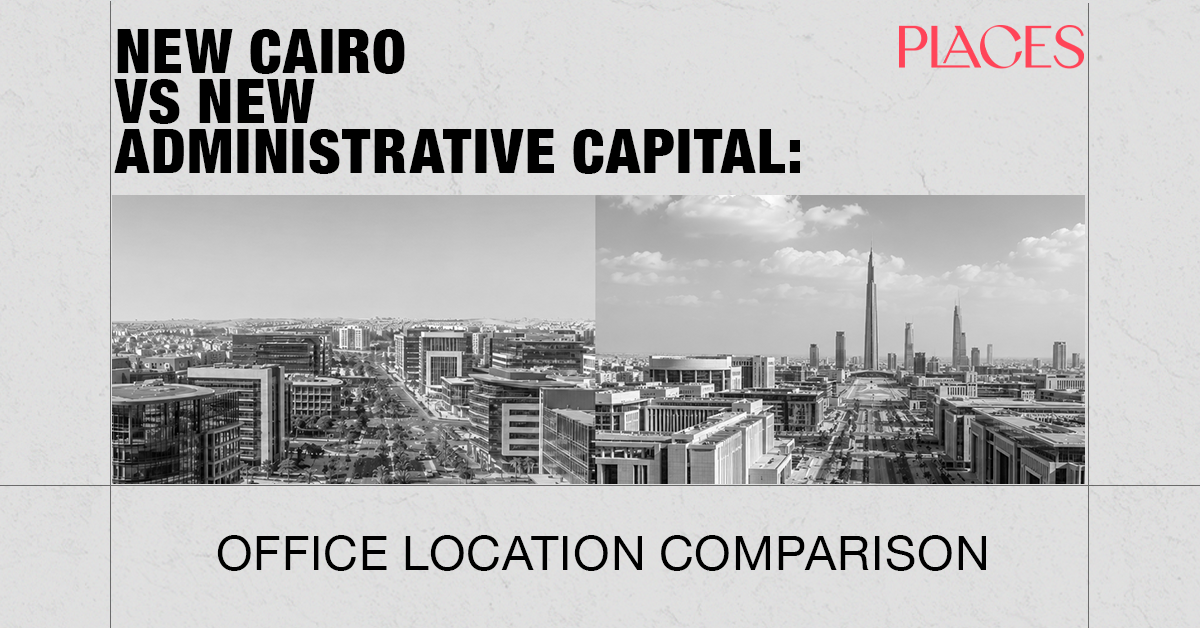
Choosing between New Cairo and the New Administrative Capital is not only a question of location. It is a question of business readiness, client access, institutional relevance, current demand, future demand, and risk tolerance.
New Cairo is usually the stronger choice for companies that need an office to operate effectively today. It has a more mature business environment, a wider range of office options, stronger surrounding services, established residential communities, and clearer demand from companies already working across East Cairo. The New Administrative Capital may be the stronger choice for companies linked to government institutions, public-sector projects, large corporate mandates, or long-term investment exposure to Egypt’s new administrative center.
The simplest way to compare them is this: New Cairo is often a current operating decision, while the New Administrative Capital is often a strategic or future-facing decision. That does not make one better than the other. It means each location serves a different type of company, investor, and risk profile.
A company that needs employees, clients, suppliers, and services to work smoothly from day one may find New Cairo more practical. A company that regularly deals with ministries, government agencies, institutional projects, or the future corporate ecosystem around the capital may find the New Administrative Capital worth considering. An investor seeking clearer tenant demand may lean toward New Cairo. An investor with a longer horizon and higher risk tolerance may study selected opportunities in the New Administrative Capital.
The right question is not: “Is New Cairo better than the New Administrative Capital?” The better question is: “Which location matches our business needs, timing, client base, and tolerance for future market risk?”
Why this comparison matters
New Cairo and the New Administrative Capital are both central to the future of East Cairo, but they are not the same type of office decision. New Cairo is an established office and residential market with business parks, administrative buildings, mixed-use districts, serviced offices, and strong links to the Fifth Settlement, Heliopolis, Nasr City, El Rehab, Madinaty, and East Cairo communities.
The New Administrative Capital is different. It is built around a long-term national relocation and development strategy, with government institutions, major infrastructure, new business districts, and future population growth. Its logic is more institutional and future-oriented. It may become highly relevant for certain businesses, but its office market should be evaluated through readiness, timing, and actual demand, not only through long-term potential.
This comparison is important because many companies confuse future importance with immediate usability. A location can be strategically important and still not be the best place for a company’s office today. At the same time, a location can be less mature today but highly relevant for a company with the right institutional client base or investment horizon.
For companies and investors, the decision should be practical: who will use the office, who will visit it, when it needs to operate, what demand exists today, and what risks are being accepted for future upside.
New Cairo: stronger business readiness today
New Cairo is generally stronger in business readiness because it already functions as a mature office market. Companies can find active buildings, operating services, established business surroundings, and a wide range of office formats. This makes it easier to evaluate a real office decision rather than relying mainly on future expectations.
For companies, business readiness means more than a delivered unit. It means employees can reach the office, clients can understand the location, services are nearby, parking can be tested, building management is visible, and the company can compare multiple alternatives before signing or buying.
New Cairo offers this in several ways. North 90 Street can suit companies that need visibility and client access. South 90 Street can suit companies looking for newer projects and a more balanced operating environment. Business parks can suit companies that need stronger corporate image and building management. Serviced offices can suit market-entry teams and companies that need speed and flexibility. Mixed-use districts can suit companies that benefit from nearby services and visitor activity.
This does not mean every New Cairo office is a good decision. Some buildings have weak parking, poor layouts, high costs, or uneven management. But the advantage is that companies can evaluate these issues based on current reality. They can visit, test, compare, negotiate, and make a decision from live market evidence.
New Administrative Capital: stronger institutional and future relevance
The New Administrative Capital has a different advantage. Its strength is linked to government presence, institutional activity, major projects, and the long-term shift of administrative and corporate gravity eastward. For companies that work with ministries, government agencies, public-sector programs, infrastructure projects, or large institutional clients, proximity to the New Administrative Capital may have real strategic value.
This can apply to consulting firms, legal advisors, engineering firms, contractors, technology providers, government-services companies, financial advisory firms, training providers, facility-management operators, and companies supporting large corporate or public-sector projects.
However, the New Administrative Capital should not be treated like a fully mature office market in the same way as New Cairo. Some areas and projects may be operational, while others may still be developing occupancy, surrounding services, and daily business activity. This changes the decision.
For a company that needs immediate office performance, the key question is not whether the New Administrative Capital is important. It is whether the specific office, building, project, and surrounding area are ready for daily use today. For an investor, the key question is not whether the city has long-term potential. It is whether the timing, price, tenant profile, and holding cost justify the risk.
Business readiness: current usability vs strategic positioning
Business readiness is the first major difference between New Cairo and the New Administrative Capital. New Cairo usually offers stronger current usability. The New Administrative Capital may offer stronger strategic positioning for selected businesses, but its readiness depends heavily on the specific project and use case.
A business-ready office is one where the company can operate with limited friction. Employees can commute, clients can visit, services are available, parking is manageable, the building is active, and maintenance is functioning. In New Cairo, many office decisions can be tested against these factors immediately.
In the New Administrative Capital, companies need to be more specific. Is the office being chosen because the company truly needs to be near institutions? Are clients already there? Are meetings happening there regularly? Is the building occupied? Are services around the project active? Is the employee commute realistic?
If the answer is yes, the New Administrative Capital may be a strong strategic choice. If the answer is still mostly based on future expectations, the company should treat the decision as a higher-risk, longer-horizon move.
Client access: where do clients actually go?
Client access can decide the location more clearly than price. If clients are based in New Cairo, the Fifth Settlement, Heliopolis, Nasr City, El Rehab, Madinaty, or East Cairo residential communities, New Cairo may be more practical. It is familiar, easier to explain, and already part of many business and residential movement patterns.
If clients are government agencies, ministries, public-sector bodies, or companies operating inside or around the New Administrative Capital, then the New Administrative Capital may offer meaningful proximity. In that case, being closer to institutional decision-makers can reduce travel time and support the company’s positioning.
The mistake is assuming that all clients will adapt to the company’s preferred location. A client-facing office should reduce friction. The visitor should be able to understand the address, reach the building, park, enter, and feel that the office supports the company’s professionalism.
For companies with mixed client bases, New Cairo may currently be the more balanced choice. For companies with a focused institutional client base around the New Administrative Capital, the capital may be more relevant.
Government and corporate relevance
The New Administrative Capital’s strongest office case is government and institutional relevance. Companies that need to be close to public-sector activity may find value there, especially if meetings, permits, tenders, advisory work, or project coordination are connected to institutions based in the capital.
This relevance can also extend to companies serving major developers, infrastructure projects, embassies, large corporate groups, or institutional clients expected to operate around the capital over time. For these companies, location is not only about convenience; it can be part of business development and relationship management.
New Cairo, however, remains more relevant for a wider range of private-sector companies today. It serves established business activity, residential demand, corporate offices, professional services, retail-administrative uses, and companies connected to East Cairo’s active commercial life.
So the distinction is important. The New Administrative Capital may be stronger for companies with institutional relevance. New Cairo may be stronger for companies with broader private-sector and operational relevance.
Current demand vs future demand
New Cairo has clearer current office demand. Companies are already leasing, buying, operating, expanding, and moving within the area. This makes it easier to assess tenant profiles, rental expectations, building performance, and resale logic.
The New Administrative Capital has a different demand story. Some demand is current, especially around government and institutional use. But a large part of the office opportunity may depend on future corporate relocation, population growth, service maturity, and wider business adoption.
For occupiers, current demand matters because it reflects whether the area is already working as a business environment. For investors, current demand affects how quickly an office can be leased and how easily it can be sold. Future demand can create upside, but it also creates timing risk.
A New Cairo office may offer more visible evidence today. A New Administrative Capital office may offer future upside if bought in the right project, at the right price, with a realistic holding period. Neither should be judged emotionally. The decision depends on whether the buyer or tenant needs certainty now or accepts uncertainty for future potential.
Risk tolerance: who should consider each location?
Risk tolerance is one of the most important factors in this comparison. New Cairo may suit lower-risk occupiers and investors who want clearer current demand, more operating evidence, and more immediate usability. The New Administrative Capital may suit companies and investors with a stronger reason to be there and a higher tolerance for timing risk.
A company that must operate smoothly from day one usually has lower tolerance for location risk. It needs a functioning environment now. A company entering a government-driven sector may accept more risk because proximity to institutions is strategically important.
An investor seeking rental income in the near term may prefer New Cairo, where demand is easier to test. An investor seeking long-term capital positioning may study the New Administrative Capital, but should be prepared for vacancy risk, slower tenant absorption, service-development risk, and uncertain timing.
The key is honesty. If the decision requires future growth to work, it should be treated as a future-facing decision. If the business needs the office to perform immediately, current readiness should matter more.
Employee commute: daily use cannot be ignored
Employees are often overlooked in office location decisions. A company may choose an office based on institutional relevance or future value, then discover that daily commute creates internal resistance. This is especially important when comparing New Cairo and the New Administrative Capital.
New Cairo may be more practical for employees living in the Fifth Settlement, Heliopolis, Nasr City, El Rehab, Madinaty, and other East Cairo areas. It may also be easier for companies already hiring from New Cairo’s residential communities.
The New Administrative Capital may work better if employees are already based nearby, if the company operates in a hybrid model, or if the team’s work is tied to institutional activity there. But if most employees live across older parts of Cairo or West Cairo, the location may increase commute pressure.
Companies should map employee locations before deciding. If the office will be used daily, commute time becomes part of the real cost. If the office is used for meetings or institutional presence only, the employee commute may be less central.
Office supply and project selection
New Cairo offers a broader and more varied office supply today. Companies can compare traditional administrative offices, business parks, serviced offices, ready-to-move units, core and shell spaces, mixed-use projects, and smaller buildings. This variety helps companies match office choice to operating model.
The New Administrative Capital also offers office supply across different projects and business districts, but project selection must be approached carefully. Buyers and tenants should verify delivery status, occupancy, infrastructure, building management, access, parking, maintenance, permitted use, and surrounding services.
In New Cairo, the risk is often choosing the wrong building in a strong market. In the New Administrative Capital, the risk may include choosing too early in a project or location that has not yet matured enough for the company’s needs.
In both locations, the unit itself matters. A good area cannot fix an inefficient layout, weak parking, poor building management, or unclear legal and operational terms.
Leasing strategy: when flexibility matters
Leasing is often the safer strategy when a company is unsure which location will fit long term. This applies strongly to the New Cairo vs New Administrative Capital decision.
A company can lease in New Cairo to test East Cairo demand, employee access, client movement, and office size. If the area works, it can renew, expand, or later buy. If it does not, leasing gives the company room to adjust.
In the New Administrative Capital, leasing may be a smart way to test institutional relevance without committing capital too early. A company can create a presence near relevant government or corporate activity while keeping flexibility if demand develops slower than expected.
Lease terms should be reviewed carefully in both locations: rent, maintenance, escalation, deposit, fit-out responsibility, rent-free period, parking, activity permissions, repair obligations, and exit conditions. Flexibility is valuable when market timing is still evolving.
Buying strategy: when ownership makes sense
Buying in New Cairo may make sense for companies that are stable, need an East Cairo base, and want an office that can serve both current use and future resale or rental demand. It may also suit investors looking for a more tested office market with clearer tenant profiles.
Buying in the New Administrative Capital may make sense for companies that have a strong strategic reason to be there, or investors with a longer time horizon and the ability to tolerate slower absorption. But the project, price, delivery status, and tenant profile must be evaluated carefully.
An owner-occupier should ask: will this office still support our business in three to five years? An investor should ask: who will rent this office, when, at what realistic rent, and after what holding cost?
Ownership is not only a financial decision. It is a commitment to a location, a building, a project, and a market timeline. The more future-dependent the decision, the more conservative the assumptions should be.
Liquidity and exit potential
Liquidity means the ability to lease, sell, or reposition the office if the company’s plans change. New Cairo may currently offer stronger liquidity because it has a larger active private-sector office market, a broader tenant base, and more established demand patterns.
The New Administrative Capital may offer future liquidity if the city’s institutional and corporate ecosystem continues to mature. But liquidity there may be more project-specific and timing-sensitive. A strong unit in a strategic project may perform differently from a unit in a less active or less serviced development.
For occupiers, liquidity matters because business needs change. The company may grow, downsize, relocate, or shift to hybrid work. For investors, liquidity is central to risk management. A property that is hard to lease or sell can tie up capital even if the long-term story is attractive.
Before buying, ask: who is the next user if we no longer need this office? If that answer is clearer in New Cairo, the risk may be lower. If the answer depends on future institutional demand in the New Administrative Capital, the investment may require more patience.
Total cost: compare the full commitment
The total cost of an office includes more than rent or purchase price. It includes maintenance, fit-out, furniture, utilities, internet, parking, moving cost, setup time, taxes or transaction costs where applicable, lease escalation, vacancy risk, and exit risk.
New Cairo may appear more expensive in some projects, but it may reduce uncertainty if the office is ready, services are active, and demand is visible. The New Administrative Capital may offer attractive pricing or future upside in some cases, but hidden costs may appear through delayed use, incomplete services, longer vacancy, or slower tenant demand.
The right comparison is not “Which location is cheaper?” It is “Which location creates better value for the company’s timing, client base, operating needs, and risk tolerance?”
A company that needs immediate operations should value readiness. An investor with a long horizon may value future positioning. But both should calculate the full cost before deciding.
Best-fit companies for New Cairo
New Cairo is often a strong fit for private-sector companies that need an office working today. This includes consulting firms, technology companies, professional services, training providers, regional offices, back-office teams, medical-related administrative uses, and companies serving East Cairo clients.
It can also suit foreign companies entering Egypt because it offers a wide range of office formats and a more active operating environment. A company can start flexibly and then scale into a larger office if the market fit is proven.
New Cairo is especially relevant when employees, clients, and services are already concentrated in or around East Cairo. It is also useful for companies that want multiple location options inside one office ecosystem.
Best-fit companies for the New Administrative Capital
The New Administrative Capital may be a strong fit for companies that are institutionally connected. This includes firms working with government agencies, public-sector projects, infrastructure, real estate development, engineering, legal advisory, financial advisory, technology, training, facility management, and corporate services linked to the new capital.
It may also suit companies that want to establish a strategic presence early, especially if their clients or partners will increasingly operate there. For these companies, location may be part of business positioning, not only convenience.
However, companies should avoid choosing the New Administrative Capital only because it is new or future-facing. The office should serve a clear business reason, and the project should be ready enough for the intended use.
Common mistakes when comparing New Cairo and the New Administrative Capital
The first mistake is assuming New Cairo is always safer. It is more mature, but individual office decisions can still fail because of weak buildings, poor parking, high costs, or inefficient layouts.
The second mistake is assuming the New Administrative Capital is automatically a future win. Future growth does not remove timing risk, vacancy risk, or the need to verify project readiness.
The third mistake is comparing prices without comparing readiness. A cheaper office may be more expensive if it cannot be used, leased, or serviced properly.
The fourth mistake is ignoring client access. If clients do not naturally move toward the location, the office may create friction.
The fifth mistake is ignoring employees. A strategic location that employees cannot use comfortably can weaken operations.
The sixth mistake is buying without an exit plan. The company or investor should know who the next tenant or buyer might be if plans change.
How Places helps companies compare both locations
At Places, we do not approach New Cairo and the New Administrative Capital as competing slogans. We evaluate them as different business decisions.
We start with the company’s purpose: immediate operations, institutional access, market entry, investment, long-term ownership, or future positioning. Then we assess client locations, employee commute, building quality, project readiness, parking, surrounding services, total cost, lease or purchase terms, demand, and exit potential.
For one company, New Cairo may be the right answer because business readiness matters most. For another, the New Administrative Capital may be the right answer because government or corporate relevance is central to the business. For an investor, the decision may depend on risk tolerance and holding period.
Our role is to help companies and investors see the real trade-off: current usability versus future positioning, clearer demand versus potential upside, lower timing risk versus higher strategic exposure.
The best office decision is not the one that sounds most promising. It is the one that matches the business case.
Frequently asked questions about New Cairo vs New Administrative Capital offices
Is New Cairo better than the New Administrative Capital for offices?
New Cairo may be better for companies that need immediate business readiness, active services, current demand, and access to East Cairo clients and employees. The New Administrative Capital may be better for companies linked to government institutions, public-sector projects, or long-term strategic positioning.
When should a company choose New Cairo?
A company should choose New Cairo if it needs an office that works today, with established services, a wider range of office options, clearer tenant demand, and stronger links to East Cairo communities and business activity.
When should a company choose the New Administrative Capital?
A company should choose the New Administrative Capital if its clients, meetings, projects, or institutional relationships are linked to the capital, or if the company is comfortable with a longer-term strategic presence and the selected project is ready enough for use.
Which location is better for investors?
New Cairo may offer clearer current demand and stronger liquidity today. The New Administrative Capital may offer future upside for investors with longer horizons and higher risk tolerance. The decision depends on project quality, price, delivery status, tenant demand, and holding cost.
Which location is better for foreign or regional companies?
Foreign and regional companies should choose based on client base, employee access, market-entry strategy, and institutional relevance. New Cairo may be better for broader private-sector operations. The New Administrative Capital may be better for government-linked or institutionally focused businesses.
Is the New Administrative Capital ready for office use?
Some parts and projects may be suitable for office use, especially for businesses with institutional relevance. However, companies should verify delivery, occupancy, services, parking, access, building management, and employee commute before committing.
Should a company rent before buying?
In many cases, yes. Renting can help a company test location fit before committing capital. This is especially useful when comparing a mature market like New Cairo with a more future-facing location like the New Administrative Capital.
Final thoughts
New Cairo and the New Administrative Capital are both important office locations, but they solve different business problems.
New Cairo is usually stronger for business readiness, current demand, operational convenience, established services, and wider office choice. It suits companies that need to operate now and investors who want clearer tenant evidence.
The New Administrative Capital is stronger for institutional relevance, government access, long-term positioning, and selected future-facing investment strategies. It suits companies that have a real reason to be close to government or large capital-linked projects, and investors who can accept timing risk.
The best decision depends on business readiness, client access, government or corporate relevance, current versus future demand, and risk tolerance. If the company needs certainty today, New Cairo may be the stronger starting point. If the company needs institutional proximity or long-term exposure to the capital’s growth, the New Administrative Capital may deserve serious review.
A good office location should not only look strategic. It should work for the business, support its clients and employees, fit its budget, and remain flexible if the market or company changes.
Leave a Reply